Indonesian Cocoa Beans: Air vs Sea Freight Cost Guide
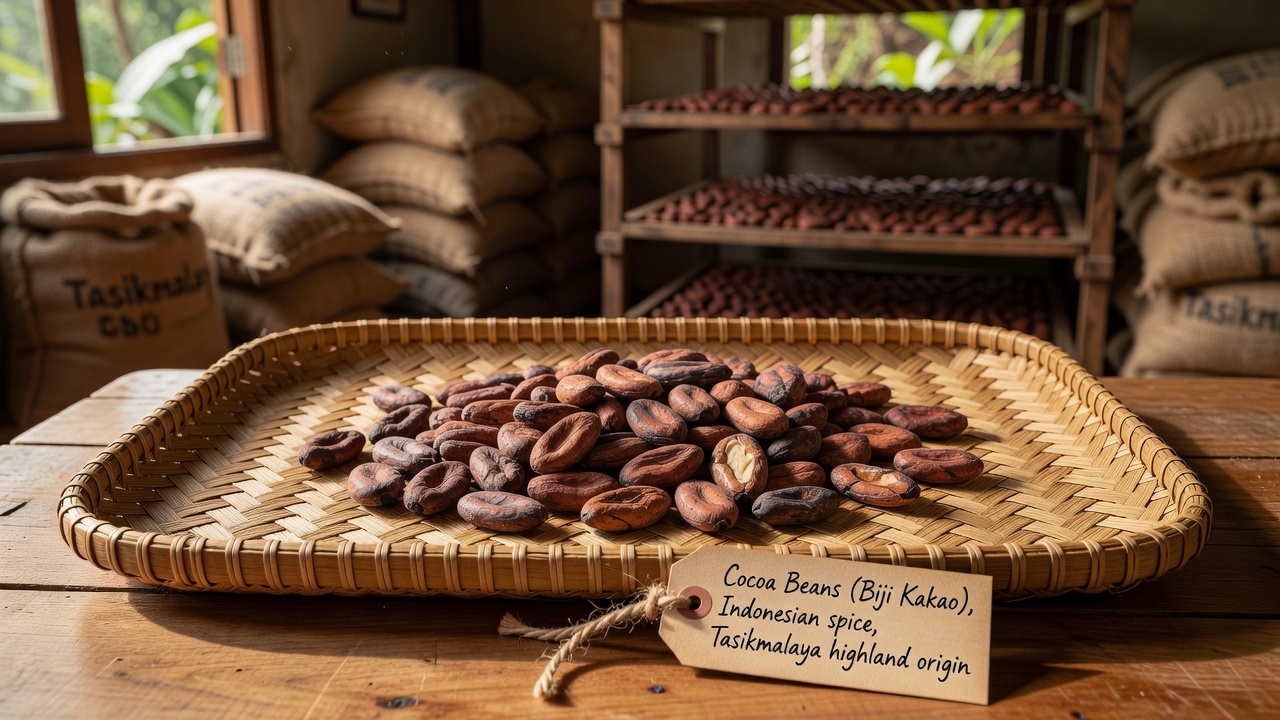
An urgent production deadline can make the cheapest freight quotation the most expensive purchasing decision. For buyers importing Indonesian cocoa beans, known locally as biji kakao, the right choice depends on how much material must arrive immediately, what a delay would cost, and whether the shipment is ready for clearance. Air freight can protect a production schedule; sea freight can preserve margins on larger replenishment orders. Comparing them properly means looking beyond the headline rate per kilogram.
For procurement planning dated September 19, 2026, this guide explains how to compare both options using transparent, illustrative calculations. TasikSpice, an Indonesian exporter based in Tasikmalaya, West Java, offers cocoa beans of Sulawesi and Sumatra origin. Product pricing is available on request, quoted FOB Tanjung Priok, Jakarta. Actual freight charges require a route-specific quotation and confirmed cargo details.
Cocoa Beans Freight Costs: Compare the Complete Shipment
Start with a common destination and delivery milestone. An airport-to-airport quotation and a port-to-port quotation do not cover the same services or establish when your factory receives its beans. Ask each forwarder to identify origin collection, export handling, main transport, destination handling, customs brokerage, and final delivery. Separate duties and import taxes so that differences in tax treatment do not obscure the transport comparison.
Air cargo is normally billed using chargeable weight: the higher of actual gross weight and volumetric weight under the carrier’s applicable rules. Dense bags of cocoa often favor actual weight, but pallets and bulky protective packaging can change the calculation. Sea freight may be quoted per container or, for less-than-container-load cargo, by weight or measurement. Minimum charges and destination fees can make small sea shipments unexpectedly expensive.
Consider this hypothetical comparison for 1,000 kilograms net of export-ready cocoa beans. Assume 1,050 kilograms gross, with the air forwarder confirming that chargeable weight also equals 1,050 kilograms. These figures are budgeting assumptions, not September 2026 market quotations, and exclude the beans themselves, insurance, duties, taxes, and exceptional inspection or storage charges.
- Air freight: Main carriage at an assumed US$4.50 per chargeable kilogram totals US$4,725. Add US$650 for origin logistics and US$850 for destination handling, brokerage, and delivery. Total modeled logistics cost: US$6,225, or approximately US$6.23 per net kilogram.
- Sea freight: Assume an LCL main-carriage quotation of US$550 for the confirmed packed dimensions, plus US$650 in origin logistics and US$950 for destination handling, brokerage, and delivery. Total modeled logistics cost: US$2,150, or US$2.15 per net kilogram.
- Air premium: Under these assumptions, air costs US$4,075 more for the shipment, equivalent to approximately US$4.08 per net kilogram.
This example compares logistics from a common origin collection point to the buyer’s facility. It should not be added wholesale to an FOB product quotation: that quotation already includes specified origin costs through loading aboard the vessel. Reconcile included services first to avoid double counting. For air shipments, request a suitable air-trade quotation, such as FCA at a precisely named handover point; FOB applies to sea and inland waterway transport.
When Air Freight Makes Sense for Bulk Cocoa Indonesia Orders
Buyers searching for bulk cocoa Indonesia supply should first calculate the quantity needed to bridge the shortage. Flying an entire replenishment order may be unnecessary when a smaller shipment can keep production running until ocean cargo arrives. The useful comparison is the extra logistics cost against the avoidable financial impact of waiting.
In the illustrative one-tonne comparison, suppose waiting for sea freight would cause five additional production days of disruption, each costing US$1,000 in genuinely avoidable losses. The resulting US$5,000 exposure exceeds the US$4,075 air premium. Air could therefore be justified, provided the beans can actually reach the factory before the shortage begins. Use lost contribution margin, stoppage costs, and enforceable penalties carefully; do not double count overlapping losses or treat all delayed sales as permanently lost revenue.
A split shipment offers another option. If a factory consumes 100 kilograms daily and needs seven days of emergency coverage, a 700-kilogram bridge shipment may address the immediate problem while the balance travels by sea. Add an appropriate operational buffer, then obtain separate quotations. Air rates, minimum fees, and handling costs do not necessarily scale proportionally from the one-tonne example.
Compare credible door-to-door schedules rather than flight duration against vessel transit alone. Collection, cargo acceptance, consolidation, transshipment, inspections, and importer readiness all affect arrival. Ask forwarders for booking availability, cargo cutoffs, expected clearance time, and a realistic delivery range. A faster transport mode cannot compensate for unavailable stock or incomplete documentation.
For an urgent order, contact TasikSpice on WhatsApp with the destination, required delivery date, emergency quantity, and total order volume. Those details support a practical comparison between air, sea, and split-shipment options.
Protect Fermented Cocoa Quality Before Paying for Speed
The value of expedited shipping depends on the quality arriving inside the bags. Cocoa beans from Theobroma cacao require disciplined harvesting and post-harvest handling: ripe pod selection, careful opening, controlled fermentation where specified, drying, sorting, and protected storage. Air freight should never become a reason to dispatch inadequately dried beans or shorten fermentation simply to meet a booking.
For fermented cocoa, agree on measurable acceptance criteria before confirming transport. These can include moisture, bean count per 100 grams, cut-test results, moldy or slaty beans, insect damage, foreign matter, and sensory characteristics. Around 7–8% moisture is a commonly used commercial reference, but the signed buyer specification should govern acceptance. Avoid relying on an undefined grade label as a substitute for test results.
During the 2026 season, confirm the actual lot’s origin, preparation status, and available quantity rather than assuming uniform characteristics across Sulawesi or Sumatra. A dependable cocoa beans supplier should connect samples, quality records, and shipment lot identification. Buyers should also establish destination-specific requirements for contaminants, traceability, and any applicable plant-health documentation before dispatch.
Use clean, food-suitable packaging and protect beans from rain, odors, infestation, and condensation. For ocean shipments, discuss container condition, moisture-control measures, and packaging suitability with the forwarder. For air cargo, confirm pallet dimensions, wrapping, and handling requirements before calculating chargeable weight. Insured value and coverage exclusions also deserve attention, particularly where deterioration or delay is concerned.
The strongest purchasing decision combines a verified lot, a complete cost comparison, and a delivery schedule tied to actual factory needs. Sea freight generally suits planned replenishment; air becomes commercially useful when its premium is lower than the disruption it can realistically prevent. Ask TasikSpice for current cocoa beans pricing and shipment planning, including FOB Tanjung Priok terms for ocean orders and an appropriate quotation basis for urgent air cargo.
Interested in sourcing premium Indonesian spices?
Contact TasikSpice on WhatsApp for FOB pricing, samples, and MOQ details.