Indonesian Vanilla Beans vs Other Origins: Buyer Guide
The cheapest vanilla quotation can become the most expensive purchase if the beans arrive unevenly cured, fail your specification, or produce less usable extract than expected. For buyers planning purchases in the 2026 season, origin matters—but so do moisture, species, curing, and delivery terms. Indonesian vanilla beans, known locally as vanili, offer an established sourcing option alongside Madagascar, Uganda, and Papua New Guinea. The strongest buying decision compares equivalent lots and total landed cost, rather than assuming one country always delivers the lowest price or highest quality.
TasikSpice, an Indonesian spice exporter based in the Tasikmalaya highlands of West Java, offers vanilla beans originating from Java and Bali. This guide explains how to assess those origins against competing suppliers for food manufacturing, trading, and culinary applications. Pricing is available on request, quoted FOB Tanjung Priok, Jakarta.
Indonesian Vanilla Beans vs Other Origins: Quality
Indonesia produces Vanilla planifolia, the commercially important species also widely cultivated in Madagascar and Uganda. Shared species does not mean identical performance. Harvest maturity, growing conditions, curing technique, and storage all influence aroma, appearance, and extraction results. Country of origin is a useful starting point for sourcing, but an approved sample and an agreed specification should determine acceptance.
Indonesia: Java and Bali give buyers access to distinct growing communities and curing practices. Indonesian lots can offer rich vanilla character, with woody or smoky notes in some batches. Those characteristics are not universal, and pronounced smoke should not automatically be treated as an origin advantage. Request samples that represent the actual shipment and evaluate whether their aroma suits dairy, bakery, beverages, or extract production.
Madagascar: Madagascar has a well-established position in international vanilla trading, and its beans are commonly associated with the familiar Bourbon vanilla profile. That recognition can help buyers selling products with origin-specific positioning. However, Madagascar origin alone does not guarantee a particular vanillin concentration, moisture level, or curing standard. Apply the same lot-level inspection used for Indonesian suppliers.
Uganda: Uganda is another source of V. planifolia worth evaluating for extraction and food applications. Its production calendar can support supply diversification, although actual availability depends on harvest and curing schedules. Compare sensory performance, analytical results, and shipment readiness rather than assuming that beans from a different harvest window are immediately export-ready.
Papua New Guinea: Buyers may encounter both V. planifolia and V. tahitensis. Confirm species before comparing offers: the floral and anise-like character associated with Tahitian-type vanilla can suit particular recipes but may not substitute directly for a conventional planifolia specification. Differences in species can explain part of an apparent price gap.
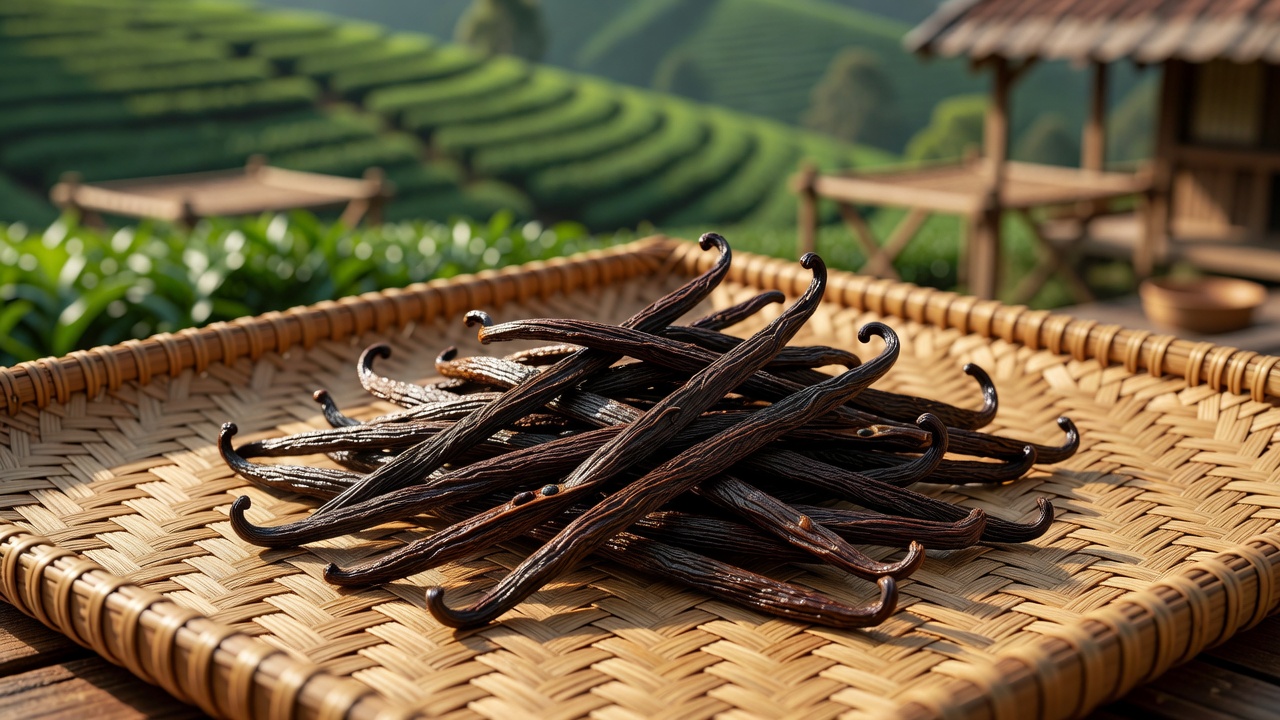
For Bali vanilla beans and competing origins alike, ask when pods were harvested and how maturity was assessed. Mature pods typically begin showing yellowing at the tip before harvest. Controlled killing, sweating, drying, and conditioning then develop the characteristic aroma. Rushed drying or insufficient conditioning can undermine an otherwise promising crop.
Commercial labels such as Grade A, gourmet, Grade B, and extraction grade are not universally standardized. Whole-bean culinary buyers often prioritize appearance, flexibility, length, and freedom from splits. Extract manufacturers may accept shorter or split beans when their chemistry and food-safety profile meet requirements. Specify moisture, length distribution, split allowance, mold exclusion, foreign matter, and packaging in writing. If comparing vanillin results, confirm the test method and whether values are reported on an as-received or dry-weight basis.
Bulk Vanilla Indonesia: Comparing FOB and Landed Prices
There is no defensible universal price ranking between Indonesia and other producing countries. Vanilla quotations change with available inventory, crop conditions, grade, order volume, currency movements, and payment terms. This article, dated September 28, 2026, does not present verified live market prices or a forecast for the 2026 season. Obtain dated quotations for comparable specifications before making a purchasing decision.
For bulk vanilla Indonesia sourcing, start with a common request-for-quotation sheet. Ask every vanilla pod supplier to quote the same species, moisture range, bean-length range, permitted defects, net weight, packaging, and testing requirements. Include order quantity, shipment window, quote validity, and the named delivery port or place. A price without those details is difficult to compare meaningfully.
Moisture is especially important. A wetter bean contains less dry matter per purchased kilogram, although moisture alone does not determine flavor or extraction performance. For industrial use, evaluate cost against usable yield under your own process. For retail or food-service use, appearance and handling may justify a different specification. Neither purchasing model should rely only on the lowest dollar-per-kilogram offer.
TasikSpice pricing is contact us, FOB Tanjung Priok, Jakarta. Under FOB Incoterms 2020, the seller delivers the goods on board the buyer-nominated vessel at the named port, and risk transfers at that point. Buyers should budget separately for ocean freight, insurance where purchased, destination handling, customs clearance, duties, and inland delivery. For containerized shipments handed over at a terminal, discuss whether FCA better reflects the actual handover. Airfreight offers also require an appropriate term rather than FOB.
Indonesian Vanilla Export Logistics and Supplier Selection
Indonesia's access to international shipping services through Jakarta can support overseas procurement, but logistics advantages depend on the destination and shipment size. Compare actual schedules from Tanjung Priok with alternatives from competing origins. Include inland collection, export preparation, consolidation, transshipment, and destination clearance—not just the advertised port-to-port transit time.
For high-value, relatively small vanilla shipments, airfreight may be commercially sensible despite its higher transport cost per kilogram. Larger consolidated orders may justify ocean transport. Request both options when timing matters, then weigh freight charges against inventory requirements and exposure to delays. Avoid assuming that geographic proximity guarantees a faster delivery.
Packaging should protect aroma while limiting moisture exchange and contamination. Agree on food-grade barrier packaging, sealing method, pack weight, and protective outer cartons. Vacuum packing is an option for suitably conditioned beans; it cannot correct excessive moisture or poor curing. Store shipments away from heat, direct sunlight, and strong odors, and establish an arrival-inspection procedure.
For an Indonesian vanilla export order, confirm the commercial invoice, packing list, transport document, and any applicable certificate of origin. Phytosanitary requirements depend on the destination and product treatment. Buyers should verify admissibility, residue limits, contaminant requirements, and any microbiological specifications with their importer or customs broker before dispatch. Organic claims require valid certification covering the relevant supply chain.
The practical choice is the origin and supplier combination that consistently meets your specification at an acceptable landed cost. Contact TasikSpice on WhatsApp to discuss Java or Bali vanilla beans, request representative samples and available lot specifications, and obtain a current FOB Tanjung Priok quotation for your 2026 purchasing plans.
Interested in sourcing premium Indonesian spices?
Contact TasikSpice on WhatsApp for FOB pricing, samples, and MOQ details.