Moisture Control in Corn Export: Sun-Drying vs Mechanical Drying for 2026
For international buyers of Corn (Maize), a single percentage point of moisture can mean the difference between a profitable shipment and a rejected container. In the high-stakes world of Indonesian corn export, maintaining precise moisture levels is not just a quality checkpoint—it’s a contractual obligation. At TasikSpice, we don’t leave that to chance. From our sourcing networks in Java and Lampung, where the grain is known locally as jagung pipil, we’ve engineered a dual drying protocol that blends traditional sun-drying with controlled mechanical finishing to deliver feed corn Indonesia buyers trust, season after season.
As we move through the 2026 harvest cycle, global demand for Zea mays from Southeast Asia is accelerating, driven by competitive pricing and reliable logistics. But quality always comes first. In this article, we’ll unpack the moisture content standards that govern international corn maize trade, pit sun-drying against mechanical drying, and show exactly how TasikSpice ensures every consignment complies—saving you from costly fumigation, mold claims, or downgrades at destination ports.
The Critical Role of Moisture Content in Corn Export
Moisture content is the single most scrutinised parameter in any corn maize export contract. Most importing countries—whether for animal feed, milling, or food processing—specify a maximum moisture level of 13% to 14%. Exceed that threshold even slightly, and you invite a cascade of risks: mycotoxin development (especially aflatoxins), insect infestation, and spontaneous heating during transit. For feed corn Indonesia shipments headed to the Middle East, South Asia, or Europe, this is non-negotiable.
The challenge in tropical origins like Java and Lampung is that corn is frequently harvested during periods of high humidity. Freshly harvested kernels can carry moisture levels of 25% to 35%. Without immediate and thorough drying, degradation begins within hours. That’s why understanding the two principal drying methods—and their interplay—is essential for any buyer evaluating Indonesian suppliers.
TasikSpice’s quality control starts at the collection point. We test every farmer lot with calibrated moisture meters, rejecting any batch that doesn’t meet pre-drying benchmarks. This upfront diligence, combined with our drying infrastructure, is what allows us to confidently offer FOB terms from Tanjung Priok with specifications that match or exceed ASTM international standards.
Sun-Drying vs Mechanical Drying: Which Method Wins for Corn Maize Export?
There’s no single “best” method—only the right combination. Let’s break down the pros and cons of each approach as applied to Indonesian corn export.
Traditional Sun-Drying
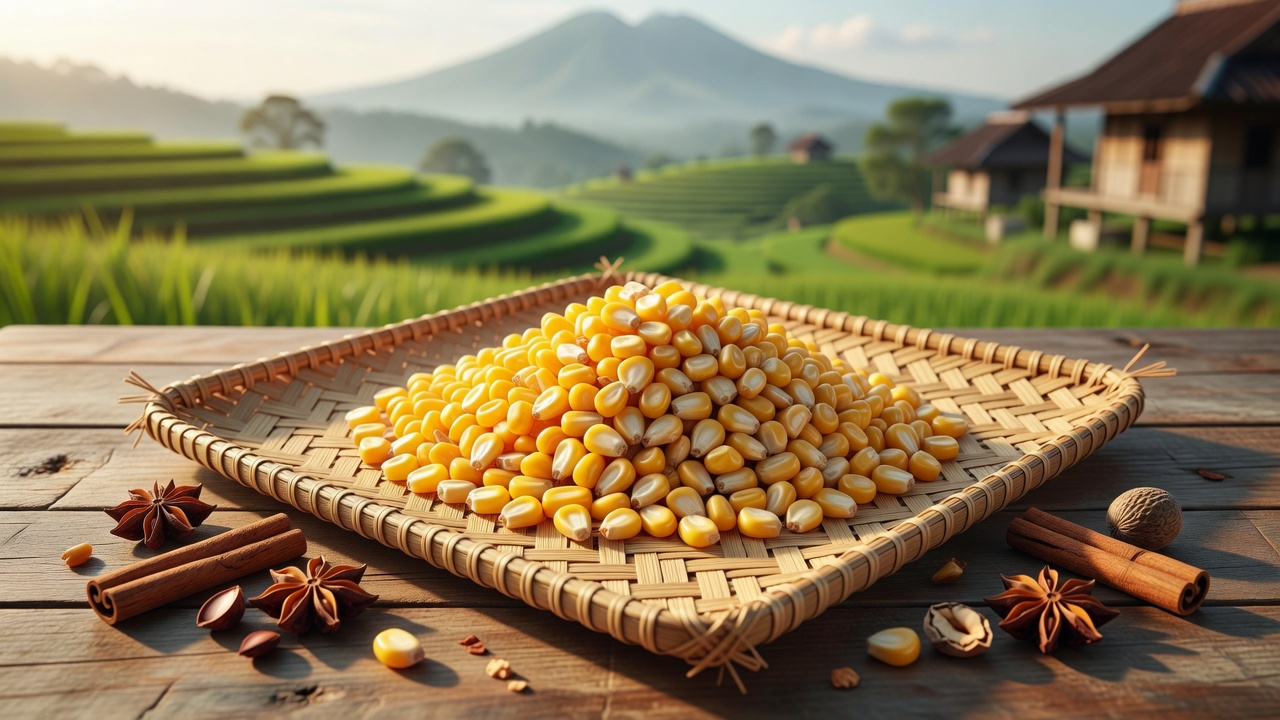
In the villages of Java and Lampung, growers have sun-dried Zea mays for generations. The grain is spread on concrete or tarpaulin floors, turned regularly, and exposed to direct sunlight. When conditions are favorable—clear skies, low humidity, and temperatures above 30°C—this method can reduce moisture to around 15-16% over two to three days.
Advantages are clear: it’s low-cost, uses zero electricity, and if managed properly, preserves the kernel’s natural color and germination potential. However, it’s weather-dependent and labor-intensive. Sudden rain can rehydrate a nearly finished batch, and uneven turning leads to moisture variation across the lot. More critically, sun-drying alone rarely achieves the sub-13% moisture content that many export contracts demand, especially for bulk container loads that require uniform dryness to prevent “sweating” during sea freight.
Mechanical Drying
Mechanical dryers—ranging from simple flat-bed units to continuous-flow industrial dryers—use heated air to rapidly and uniformly reduce moisture. They operate independently of climate, can handle large volumes per cycle, and, crucially, can achieve moisture levels as low as 10-12% with precision. For feed corn Indonesia destined for pelleted feed manufacturers or long-haul voyages, this consistency is gold.
The trade-off is higher capital and operational cost. If not carefully managed, excessive heat can crack kernels or impair their nutrient profile. But modern low-temperature drying techniques (below 45°C) mitigate this, preserving protein digestibility and reducing stress fractures. That’s the technology TasikSpice integrates at our central processing facilities.
How TasikSpice Ensures Export-Grade Corn Moisture Compliance
Our approach is a hybrid model that harnesses the best of both worlds. Here’s the step-by-step process we’ve refined for the 2026 season to guarantee every parcel of corn maize we ship meets international moisture specifications.
Stage 1: Farmer-Level Sun-Drying. All contracted farmer groups sun-dry their freshly harvested corn to an initial 16-18% moisture content. This stage is closely supervised by our field agents, who enforce minimum drying time (at least three full sun days) and monitor kernel temperature to prevent scorching. By using tarpaulin sheets and raised drying beds, we minimize contamination and ensure pests are kept at bay.
Stage 2: Pre-Collection Testing. Before any lot enters our warehouse, we run a rapid moisture analysis using a grain analyzer. Batches exceeding 18% are immediately rejected or re-dried at source. This gatekeeping prevents high-moisture corn from contaminating compliant stock.
Stage 3: Controlled Mechanical Finishing. At our central processing hub, sun-dried corn enters a low-temperature mechanical dryer set to 40-45°C. Over a period of 4-6 hours, moisture is uniformly reduced to the target 13% (or as specified by the buyer—some contracts require 12% for extra-long journeys). Real-time sensors and automatic shut-offs prevent over-drying, which could lead to kernel breakage and weight loss.
Stage 4: Post-Drying Grading and Stabilization. After mechanical drying, the corn is cooled and allowed to temper for 24 hours in aerated silos. This stabilizes moisture equilibrium, ensuring the final test certificate truly represents the shipment’s condition. Our quality lab then re-tests for moisture, aflatoxin, and physical purity. Only lots that clear all parameters advance to export packaging.
This dual-phase system—sun-drying for economic and sensory quality, mechanical finishing for precision—has proven itself across dozens of containers to markets in the Middle East and South Asia. Buyers consistently note the absence of moldy kernels and the uniformity of color and size, which directly correlates with our moisture management.
At TasikSpice, we take pride in transforming jagung pipil from highland fields into a globally competitive commodity. Our 2026 crop is already showing exceptional kernel size and brightness, thanks to favorable growing conditions and our farm-level extension programs. Whether you need animal feed grade, food-grade milling corn, or customized specifications, we can tailor the drying protocol to match.
Don’t let moisture jeopardize your supply chain. Partner with a supplier who treats drying as a science, not an afterthought. Contact TasikSpice today to discuss your requirements for Indonesian corn export and receive a prompt FOB Tanjung Priok quotation.
Reach our export team directly on WhatsApp at +62 812-9869-9940—we’re ready to share quality samples, lab reports, and shipping schedules for the 2026 season.
Interested in sourcing premium Indonesian spices?
Contact TasikSpice on WhatsApp for FOB pricing, samples, and MOQ details.