Moisture Control for Export-Grade Green Coffee Beans: Sun vs Mechanical Drying
In the global spice and specialty coffee trade, moisture content isn't just a technical detail—it's the thin line between a premium, shelf-stable shipment and a rejected container of moldy, degraded beans. For importers of green coffee beans (known locally as kopi biji hijau), understanding how moisture is managed from harvest to container is essential to securing consistent quality. At TasikSpice, we've turned this critical parameter into a core competitive advantage, drawing on generations of highland farming wisdom and modern drying infrastructure to deliver Indonesian green coffee that meets the strictest international standards.
As we move through the 2026 harvest season across the volcanic slopes of Java and Sumatra, the question our buyers ask most is: how do you guarantee moisture compliance? This article explores the two dominant drying methods—sun-drying and mechanical drying—and reveals the integrated approach TasikSpice uses to ensure every batch of unroasted coffee arrives at its destination with precision moisture levels, rich flavor potential, and absolute food safety.
Why Moisture Content Defines Export-Grade Green Coffee Quality
Green coffee beans are living seeds. After depulping and fermentation, they carry around 50–60% moisture. The goal of drying is to reduce this to a stable range of 10–12%—a standard upheld by the Specialty Coffee Association, ICO guidelines, and major importing countries. Exceeding that threshold invites mold growth, ochratoxin A production, and musty off-flavors. Over-drying below 9%, on the other hand, risks cracking, loss of volatile aromatics, and uneven roasting. For Robusta coffee and Arabica alike, the ideal moisture window protects cellular structure while preserving the cup's potential.
International buyers increasingly demand moisture certificates with every shipment. A deviation of even 0.5% can trigger a price downgrade or a costly fumigation requirement at the destination port. At TasikSpice, we see moisture management as a non-negotiable pillar of our specialty coffee Indonesia promise. Our post-harvest protocol integrates both sun-drying and mechanical drying in a controlled sequence, backed by digital monitoring and sealed warehouse storage.
Sun-Drying: The Traditional Floor of Indonesian Green Coffee
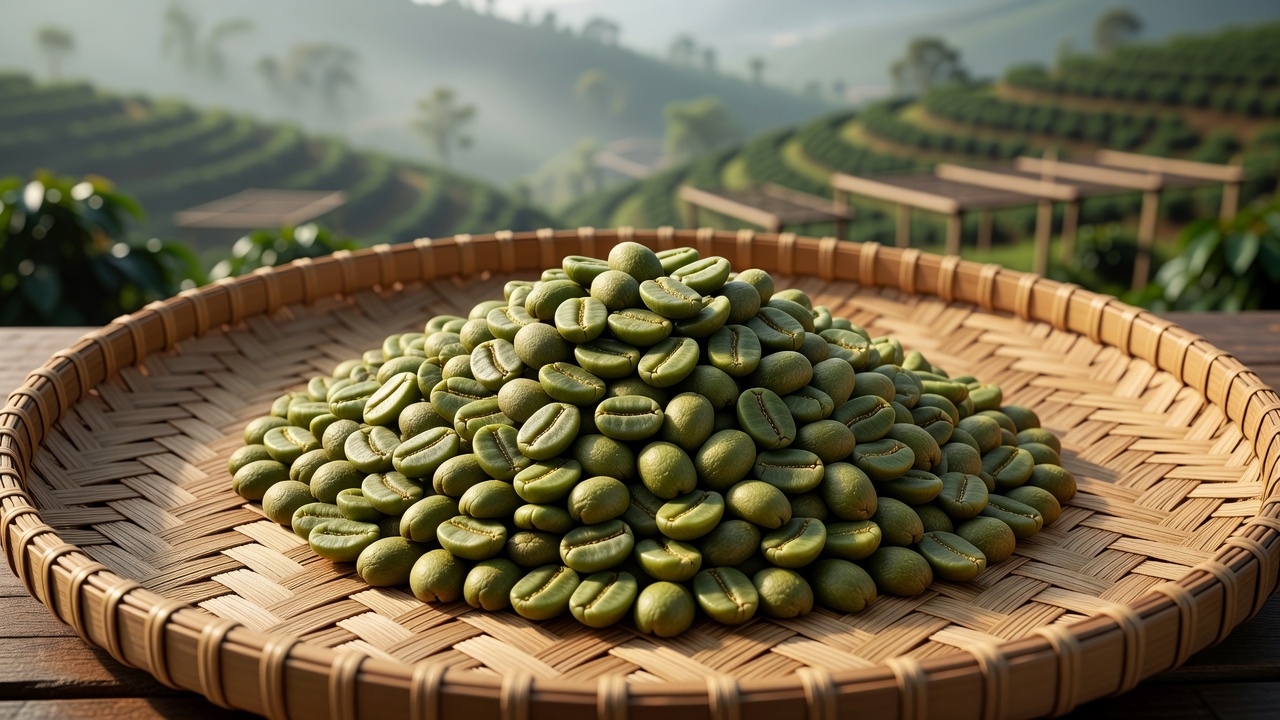
For centuries, smallholder farmers in the highlands of Tasikmalaya and Gayo have spread their parchment coffee on raised beds or concrete patios under the equatorial sun. Sun-drying is low-cost, environmentally benign, and when managed properly, capable of producing complex, fruity cup profiles that mechanical heat can sometimes flatten. The gentle warmth (typically 30–40°C) allows for a slow, enzymatic development that many specialty buyers associate with origin character.
However, sun-drying is deeply weather-dependent. In the humid tropical climate of West Java and North Sumatra, afternoon clouds or unexpected rain can pull beans away from their target moisture for hours, even days. Extended drying times—often 10–14 days or more—increase the risk of rewetting, contamination by dust or insects, and uneven drying if layers are not turned frequently. Manual raking is labor-intensive and can lead to inconsistency across a batch. For export-grade Indonesian green coffee, reliance solely on sun-drying is a gamble that TasikSpice is not willing to take. Yet the flavor benefits are too valuable to discard entirely.
Mechanical Drying: Precision and Consistency at Scale
Mechanical dryers, using heated forced air, can reduce coffee moisture from 25–30% down to 11% in a matter of hours. This method offers unparalleled control over temperature, airflow, and drying rate. At TasikSpice's collection and processing center in Tasikmalaya, we employ rotating drum dryers and flatbed dryers calibrated to never exceed 45°C for the first phase—the critical period when seed enzymes are still active. Higher temperatures can case-harden the bean, locking in interior moisture and creating a deceptive outer shell that later spoils.
The key advantage of mechanical drying is its independence from weather. It ensures that large volumes harvested during the peak 2026 season can be brought to stable moisture quickly, avoiding the microbiological risks of prolonged drying. It also allows us to blend smallholder lots into uniform export parcels with a moisture variation of less than ±0.3%. However, the capital investment and energy costs are significant. Mechanical drying alone can sometimes strip away some of the delicate floral notes that slow sun exposure develops. That's why TasikSpice never relies on a single method.
How TasikSpice Combines Both Methods for Perfect Moisture Compliance
The optimal drying curve for green coffee resembles a reverse hockey stick: fast initial drying to remove surface moisture, then a slower finish to equalize internal moisture. Our protocol executes this in three stages:
- Stage 1 – Sun-prewithered drying. After washing, high-moisture parchment is spread on raised African beds inside our ventilated solar tunnels. For 2–3 days under clear skies, the beans lose the first 15–20% moisture exposure. This gentle start allows the natural enzymatic processes to develop sweetness and body. Workers turn the beans hourly using sanitized wooden rakes.
- Stage 2 – Mechanical finish. Once moisture reaches around 25%, the parchment is transferred to our flatbed dryers. Here, recirculated air at precisely 38–42°C reduces moisture to the target 11% over 8–12 hours. We use digital moisture meters (calibrated daily against an oven-drying reference) to monitor at multiple depth points, ensuring no layering effect.
- Stage 3 – Stabilization and conditioning. The dried parchment is held in ambient-conditioned silos for 48–72 hours before hulling. This rest period lets moisture equalize between the parchment and the bean, preventing the false dryness that can lead to rejects later. After hulling and grading, the green coffee beans are vacuum-packed in GrainPro or hermetic bags, with a final moisture check logged and attached to every pallet.
This hybrid system consistently produces unroasted coffee with moisture content between 10.8% and 11.4%—well within the export sweet spot. It also minimizes the carbon footprint: solar energy powers the initial phase, and the mechanical dryers run on biomass from coffee husks. For buyers seeking organic-certified or simply fully traceable Indonesian green coffee, this method offers a transparent, defensible quality narrative.
Meeting International Buyers' Standards in the 2026 Market
The demand for specialty coffee Indonesia continues to grow in Europe, North America, and the Middle East, but so does the scrutiny. Large roasting companies now routinely test incoming containers for water activity (aw) in addition to moisture content. Our process targets a water activity below 0.60—a level that inhibits all mold and bacterial growth even during transit. This is achieved through the combination of precise drying and hermetic packaging.
Compared to coffee from other origins, Indonesian green coffee naturally carries a higher initial moisture due to wet-hulling traditions and high-altitude growing conditions. However, at TasikSpice, we show that with disciplined post-harvest handling, Robusta coffee and Arabica from Java and Sumatra can equal or surpass the uniformity of Central American lots. We provide every buyer with a Certificate of Analysis that includes moisture, water activity, density, screen size, and a sensory report from our in-house Q grader. This documentation allows importers to bypass multiple re-tests and confidently plan their roasting profiles.
No matter if you source full container loads or single-pallet trial shipments, TasikSpice ensures that the moisture level you see on paper is exactly what arrives at your warehouse. Our commitment to drying precision is backed by Indonesia's long coffee heritage and the altitude advantage of our Tasikmalaya base—where cool mountain air naturally slows fermentation, adding another layer of quality before drying even begins.
Ready to taste the difference that perfect moisture makes? Contact TasikSpice via WhatsApp at +62 812-9869-9940 to request 2026 harvest samples, complete with moisture certification and FOB Tanjung Priok pricing. Let's discuss how our export-grade green coffee beans can elevate your next blend.
Interested in sourcing premium Indonesian spices?
Contact TasikSpice on WhatsApp for FOB pricing, samples, and MOQ details.