Moisture Control for White Cardamom: Sun vs Machine Drying
Nothing undermines a spice shipment faster than mold. For international buyers sourcing white cardamom, excess moisture isn’t just a quality flaw—it’s a financial risk, leading to rejections, aflatoxin contamination, and lost trust. At TasikSpice, our white cardamom (Amomum compactum), known locally as kapulaga jawa, is grown in the pristine highlands of Tasikmalaya, West Java. We’ve turned moisture control into a competitive advantage, using a hybrid drying process that marries traditional sun-drying with modern mechanical finishing to ensure every kilogram meets the strictest export standards. In this article, as our 2026 harvest reaches the market, we explore the science of moisture in cardamom, compare drying techniques, and show why TasikSpice is the go-to cardamom spice supplier for bulk cardamom Indonesia buyers worldwide.
Why Moisture Content Makes or Breaks Export Cardamom
Freshly harvested white cardamom pods can contain up to 80% water. For safe international trade, that moisture must be reduced to between 8% and 12%. The precise threshold depends on the buyer’s specifications, but the most stringent importers in the Middle East and Europe demand a maximum of 10%. Why? Moisture beyond this level creates a breeding ground for molds, including Aspergillus flavus, which produce carcinogenic aflatoxins. Even if mold does not visibly form, elevated water activity accelerates enzymatic browning, degrades essential oils, and shortens shelf life. A shipment of Indonesian cardamom that arrives with uneven moisture can develop condensation inside shipping containers, causing caking and localized spoilage. For exporters, a single rejected container can erase months of profit.
International standards such as ISO 939:1980 provide methods for determining moisture content, while regulations like EU Commission Regulation (EC) No 1881/2006 set maximum levels for aflatoxin B1 and total aflatoxins in spices. To compete in the white cardamom export market, suppliers must not only meet these benchmarks on paper but consistently deliver. That’s why drying is the most critical post-harvest step.
Traditional Sun-Drying versus Mechanical Drying
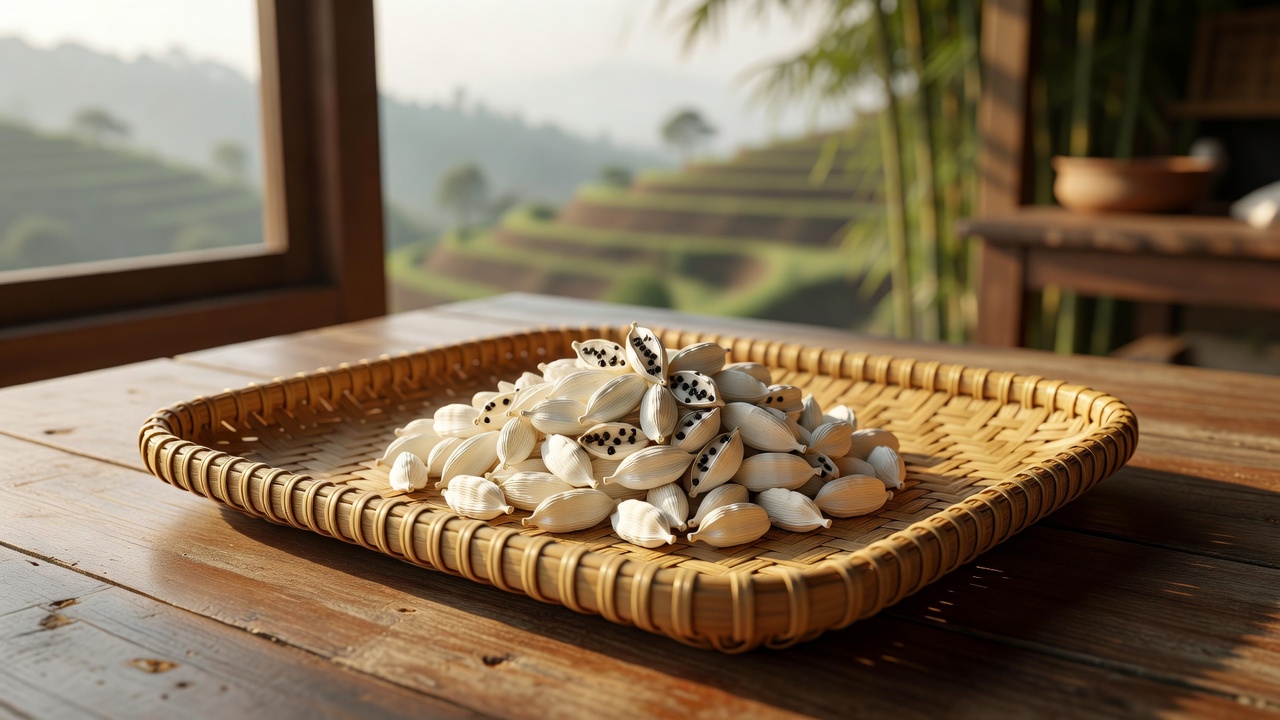
In the Tasikmalaya highlands, smallholder farmers have traditionally sun-dried cardamom on woven bamboo trays or tarpaulins. The method is simple, cost-effective, and uses free solar energy. Under the tropical sun, pods can lose moisture to around 20% within two days. However, sun-drying is anything but predictable. Heavy afternoon rains, common in West Java, can suddenly rewet the crop, forcing farmers to rush to cover the trays. Uneven heating leads to variability—some pods might reach 10% moisture while others in shaded spots still hold 18%. Dust, insects, and bird droppings add contamination risks. Moreover, fermentation can begin internally if the pods are not turned frequently, imparting off-flavors that ruin the delicate camphoraceous notes of white cardamom.
Mechanical drying, on the other hand, puts the exporter in control. Cabinet or tunnel dryers circulate warm air at regulated temperatures—typically 40°C to 50°C for cardamom—and can bring moisture down to a precise target in 12 to 24 hours. The uniform environment eliminates hotspots and prevents re-wetting. Critically, it also kills any insect eggs present, a bonus for phytosanitary compliance. Yet mechanical drying is not foolproof: higher temperatures or prolonged drying can evaporate volatile oils like 1,8-cineole, reducing aroma intensity and economic value. Over-drying below 8% makes capsules brittle and prone to crushing. Energy costs and capital investment also add to the final price. For these reasons, a pure mechanical-only approach often struggles to balance quality and cost.
How TasikSpice Achieves Perfect Moisture Control
TasikSpice has developed a hybrid drying protocol that harnesses the best of both worlds. Immediately after harvest, white cardamom capsules are washed in clean spring water to remove field debris. They are then spread in a single layer on raised, food-grade plastic mesh trays inside a covered but open-sided drying house. Here, natural airflow and gentle sunlight reduce the moisture content to approximately 20–25% over one to two days. Crucially, these drying racks are protected by fine-mesh netting, which keeps out birds and insects while allowing UV radiation to sanitize the surface naturally. Our workers turn the pods hourly to ensure even exposure.
At this point, the partly dried cardamom moves into our low-temperature mechanical dryers. Set at a steady 40°C with controlled humidity, these tunnel dryers finish the job with surgical precision. We target exactly 10% moisture—low enough to guarantee a water activity well below 0.65, which inhibits all mold and bacterial growth, but high enough to preserve the pale ivory color and a rich volatile oil profile. Throughout the drying cycle, operators use calibrated pin-type moisture meters at multiple sampling points; batches are only released when every reading falls within the 9.5%–10.5% range.
After cooling, the white cardamom is packed immediately. TasikSpice uses multi-layer polyethylene bags with an oxygen absorber and hermetic heat-sealing. This creates a low-oxygen, low-humidity microenvironment that keeps the product stable during the 4–6 week sea freight to destinations like Dubai, Jeddah, or Hamburg. For the 2026 season, our export-grade white cardamom is available at an FOB price of $10.30 per kilogram from Tanjung Priok, Jakarta, reflecting the added value of our rigorous process.
Our commitment to transparency goes further. Every shipment includes a Certificate of Analysis with moisture content, essential oil percentage, and aflatoxin screening results. We are happy to share third-party lab reports and welcome buyer inspections. As a leading Indonesian cardamom supplier, TasikSpice understands that your reputation depends on the quality of the spices you import.
If you are searching for a dependable source of bulk cardamom Indonesia, we invite you to experience the TasikSpice difference. Contact our team via WhatsApp at +62 812-9869-9940 to request a moisture specification sheet, discuss volume discounts, or order a sample from our 2026 harvest. Let us help you build a spice supply chain that never dilutes your quality standards.
Interested in sourcing premium Indonesian spices?
Contact TasikSpice on WhatsApp for FOB pricing, samples, and MOQ details.