Visual Nutmeg Grading: Color, Aroma & Kernel Integrity Checklist
A single glance at a sack of whole nutmegs can reveal their entire journey — from the volcanic slopes of North Sulawesi to the drying floors of Maluku. For international spice buyers, the first line of defense against substandard shipments isn't a lab report; it's a trained eye. The visual cues of color, aroma, and kernel integrity tell a story of harvest timing, drying care, and post-harvest handling. As a dedicated nutmeg spice supplier, TasikSpice sources only Myristica fragrans that meets the strictest visual standards, and we believe every buyer should demand the same. As the 2026 harvest approaches, with promising yields from Indonesia's prime growing regions, mastering this visual checklist will empower you to secure the finest bulk nutmeg Indonesia has to offer.
Known locally as pala, nutmeg is Indonesia's signature spice, accounting for over 75% of global supply. Yet not all nutmegs are equal. While laboratory analysis quantifies volatile oil content and aflatoxin levels, a physical inspection on arrival or even through video calls with your supplier can filter out up to 90% of quality issues. The following guide distills decades of exporter know-how into a practical visual grading checklist, blending traditional wisdom with modern buyer expectations. When you partner with TasikSpice, you're not just purchasing a commodity — you're tapping into a lineage of Indonesian spice craftsmanship that insists every kernel tells a story of excellence.
Why Visual Grading Matters in Bulk Nutmeg Indonesia
The global spice trade moves fast, but nutmeg quality unfolds slowly. Unlike ground spices, whole nutmegs preserve their aromatic soul inside a hard shell long after harvest. Visual grading is the buyer's first chance to assess whether that soul remains vibrant. A kernel's external appearance directly correlates with its internal chemistry: color indicates drying evenness and mold risk, aroma hints at essential oil content, and kernel shape reflects maturity and handling. For bulk shipments sourced from island cooperatives, where drying techniques vary from sun-baked concrete to smoke houses, these visual markers become critical quality differentiators.
Indonesia’s equatorial climate demands rigorous post-harvest practices. Nutmeg fruits take up to eight weeks to dry properly, during which the kernels can lighten, attract mold, or crack if rushed. At TasikSpice, our supply partners in North Sulawesi and Maluku adhere to a sun-drying protocol that gradually reduces moisture to a stable 8-10%. The result is a kernel that visually announces its quality: weighty, uniformly hued, and redolent with locked-in oils. When you inspect a batch, you're looking for the fingerprints of this patient process.
Color: The Immediate Tell of Nutmeg Quality
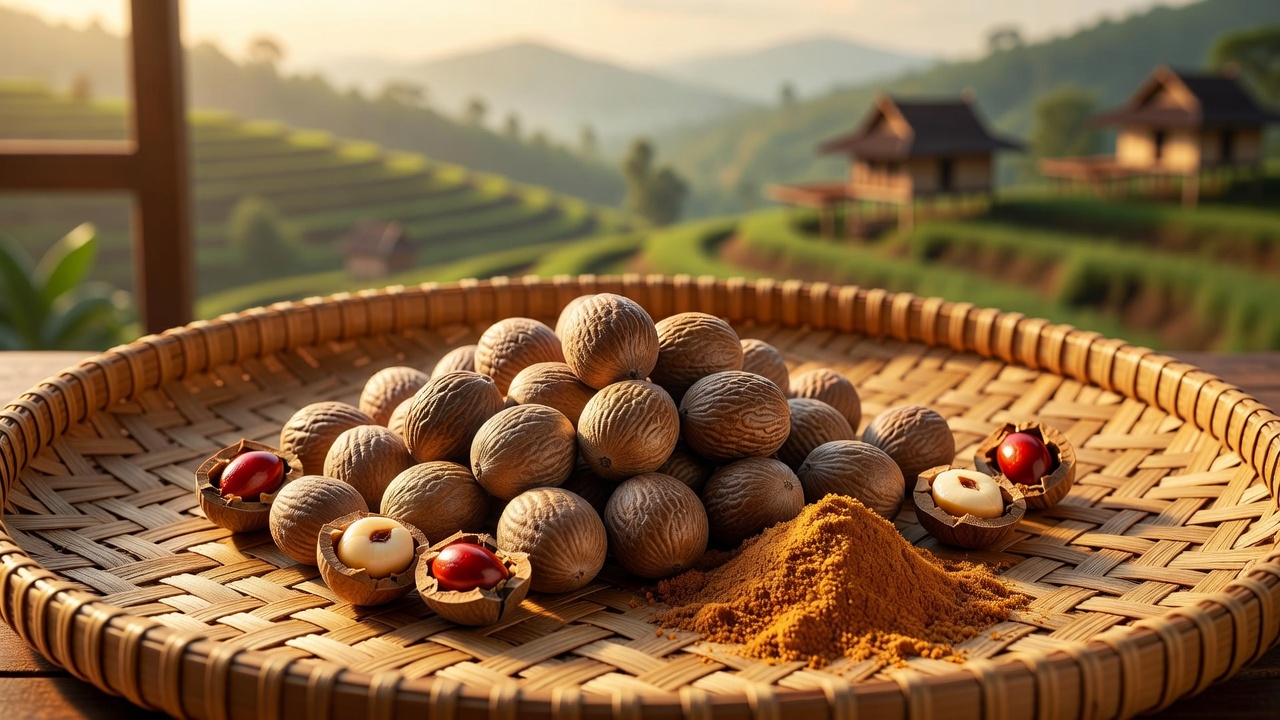
Pick up a handful of whole nutmegs and let the color speak. Premium-quality Myristica fragrans kernels exhibit a rich, uniform dark brown — almost mahogany — with a subtle, natural sheen. This hue comes from evenly dried seed coats imbued with reddish-brown essential oils. Any deviation is a red flag. Pale, tan, or bleached-looking nutmegs indicate over-drying or exposure to direct, intense sunlight for too long, which evaporates precious volatile oils and leaves the kernel starchy and bland. At the other extreme, dark gray or black patches suggest fungal contamination or storing damp kernels, a common issue in high-humidity regions. TasikSpice graders reject any nutmeg with discoloration exceeding 5% surface area, ensuring our bulk nutmeg Indonesia shipments maintain that coveted deep-brown identity.
Another nuance is the mace line — the slight groove where the aril was attached. In honestly dried nutmegs, this line remains clean and shallow, without flaking or mold spotting. A buyer's loupe or a good camera can reveal pitting or spiderweb mold that the naked eye misses. When evaluating color, insist on samples under natural daylight; artificial lighting can mask pale tones. As part of our 2026 commitment, TasikSpice provides real-time video walkthroughs of sack interiors, so you can personally confirm this visual benchmark before shipping.
Aroma: The Invisible Signature of Premium Myristica fragrans
Aroma is the soul of nutmeg, but your nose can detect it without breaking the shell. Scratch a kernel lightly with your fingernail or rub it between your fingers — the friction warmth should release a heady, sweet, and distinctly spicy fragrance. Indonesian nutmeg, particularly from volcanic highlands, is famed for its high myristicin and elemicin content, which give a warm, penetrating note with hints of clove and pine. If the aroma is faint, musty, or reminiscent of damp cardboard, the oils have oxidized or the batch is old. A truly fresh kernel will almost 'sting' the nostrils with its intensity, even without crushing.
For a more reliable check, split a few representative kernels. The interior should be noticeably more aromatic, with a resinous, oily feel when pressed between fingers. A bland, woody smell points to exhausted oils. Grades like 'FAQ' (Fair Average Quality) might pass for grinding purposes, but for premium whole nutmeg intended for gourmet retail or direct culinary use, only the bold, persistent aroma of high-volatile-oil kernels will do. TasikSpice's in-house quality control tests oil content gravimetrically, but our field staff are trained to sniff-test every 50kg sack — because no machine can yet replicate a human nose's ability to flag subtle off-notes.
Kernel Integrity: The Uncompromising Measure of Value
Here, the eyes and hands work together. A whole nutmeg should feel heavy for its size, dense like a polished pebble. Hold a kernel up: it should be plump and symmetrical, with a rounded, undamaged shell. Any cracks, chips, or wormholes compromise more than just looks — they expose the inner seed to air, accelerating oil evaporation and inviting insect infestation. In the bulk trade, 'Sound' and 'Whole' are formal grading terms that denote this integrity. TasikSpice's standard export lot guarantees less than 2% broken or worm-damaged kernels, far below the 5% tolerance often seen in lower-tier shipments.
Shake a dry nutmeg near your ear. If you hear a distinct rattling sound, the inner seed has shriveled and separated from the shell, a condition known as 'floating.' Such kernels are light, low in oil, and drastically inferior. Visual grading also extends to size consistency. While there is no universal global standard, Indonesian exporters often classify by diameter: A-grade (over 9mm), B-grade (7-9mm), and C-grade/small. A uniform batch is easier to process and signals better sorting. Our 2026 harvest will again be meticulously hand-sorted by experienced women in Maluku villages, preserving the kernel's integrity from tree to container.
The Spice Buyer’s Visual Grading Checklist
Use this checklist as a rapid field guide — whether you're visiting a drying yard or reviewing shipment photos. Each point is a non-negotiable for premium bulk nutmeg.
- Color: Deep, uniform dark brown, free from pale blotches, black mold spots, or gray areas. Surface should have a gentle natural sheen, not a dull, dusty appearance.
- Aroma: Strong, sweet, and penetrating when scratched; no musty, sour, or flat notes. Crushed kernel should feel oily and intensely fragrant.
- Weight & Feel: Dense and heavy in hand. A lightweight, 'hollow' feel indicates dehydration or worm damage.
- Kernel Wholeness: No visible cracks, breaks, or insect boreholes. Check the mace line for cleanliness.
- Sound Check: Shake gently — a silent kernel is a sound kernel. Rattling means internal shrinkage.
- Size Uniformity: For specialty orders, verify that 90% or more fall within the specified sieve size.
Armed with these sensory benchmarks, you transform from a passive receiver to an active quality gatekeeper. Remember, consistent quality builds your brand reputation as much as it does ours.
When you're ready to source the 2026 crop, partner with a supplier who welcomes your scrutiny. TasikSpice ships nutmeg from the volcanic highlands of Indonesia, backed by rigorous visual grading and transparent communication. Let our team walk you through live samples, current FOB Tanjung Priok pricing, and tailor-made bulk solutions. Reach out now on WhatsApp at +62 812-9869-9940 to start the conversation and secure your share of this year's exceptional harvest.
Interested in sourcing premium Indonesian spices?
Contact TasikSpice on WhatsApp for FOB pricing, samples, and MOQ details.