Organic Cocoa Beans: Indonesia's 2026 Certification Journey
Every chocolate manufacturer in Europe, Japan, and the Gulf now asks the same question before signing a supply contract: can you prove your cocoa is clean? As global residue standards tighten and organic confectionery grows at double-digit rates, the answer can no longer be verbal assurance. It must be documented, audited, and traceable — from a single tree to a loaded container. That is precisely the journey TasikSpice and its partner farming networks began several seasons ago, and in the 2026 season it is starting to pay off. This article walks buyers through our organic certification journey for Indonesian cocoa beans — known locally as Biji Kakao — from the shade gardens of Theobroma cacao in Sulawesi and Sumatra to the export docks of Tanjung Priok, Jakarta.
Why Organic Certification Matters for Indonesian Cocoa
Indonesia remains one of the largest cocoa producers in the world, and Sulawesi alone contributes roughly two-thirds of national output. Sulawesi cocoa has earned a solid reputation among industrial chocolate makers for its consistent bulk quality, earthy depth, and reliable year-round supply. But reputation alone no longer wins contracts at a premium.
Certified-organic cocoa typically commands 20–30% price premiums over conventional lots, and demand for organic chocolate ingredients continues to climb across the EU, the Middle East, and South Asia. For buyers who need bulk cocoa, Indonesia's volume advantage only becomes truly valuable when it converts the bulk cocoa Indonesia is known for into a traceable, brand-ready ingredient. Certification also protects buyers: organic audits require soil testing, buffer zones, and full input records, which dramatically reduces the risk of chemical residues slipping into a shipment.
The Transition: From Conventional Fields to Pesticide-Free Cocoa
TasikSpice's roots are in the Tasikmalaya highlands of West Java, where our farmer network first transitioned spice gardens to pesticide-free cultivation. Encouraged by those results, we extended the same transition model to partner cocoa cooperatives in Sulawesi and Sumatra beginning in early 2024.
Organic standards are demanding, and rightly so. For a perennial crop like cocoa, both EU and USDA frameworks require a 36-month conversion period before a plot may be harvested as certified organic. During this window, our partner farmers are:
- Eliminating synthetic inputs — replacing chemical pesticides and herbicides with integrated pest management (IPM), shade management, and botanical controls such as neem.
- Rebuilding soil health — composting cocoa pod husks, applying organic matter, and planting leguminous shade trees that fix nitrogen naturally.
- Establishing traceability — mapping every smallholder plot with GPS coordinates so each sack can be traced back to its farm of origin.
- Training and record-keeping — field officers document every harvest, input, and drying batch to satisfy third-party auditors.
Because the first plots entered conversion in early 2024, the first fully certified-organic harvest is expected with the 2027 crop. For the 2026 season, we can offer conventional Sulawesi cocoa alongside documented in-conversion lots — an early-mover advantage for buyers who want to lock in transitional supply and pricing before certified volumes reach the market.
Fermentation Standards Under Organic Protocols
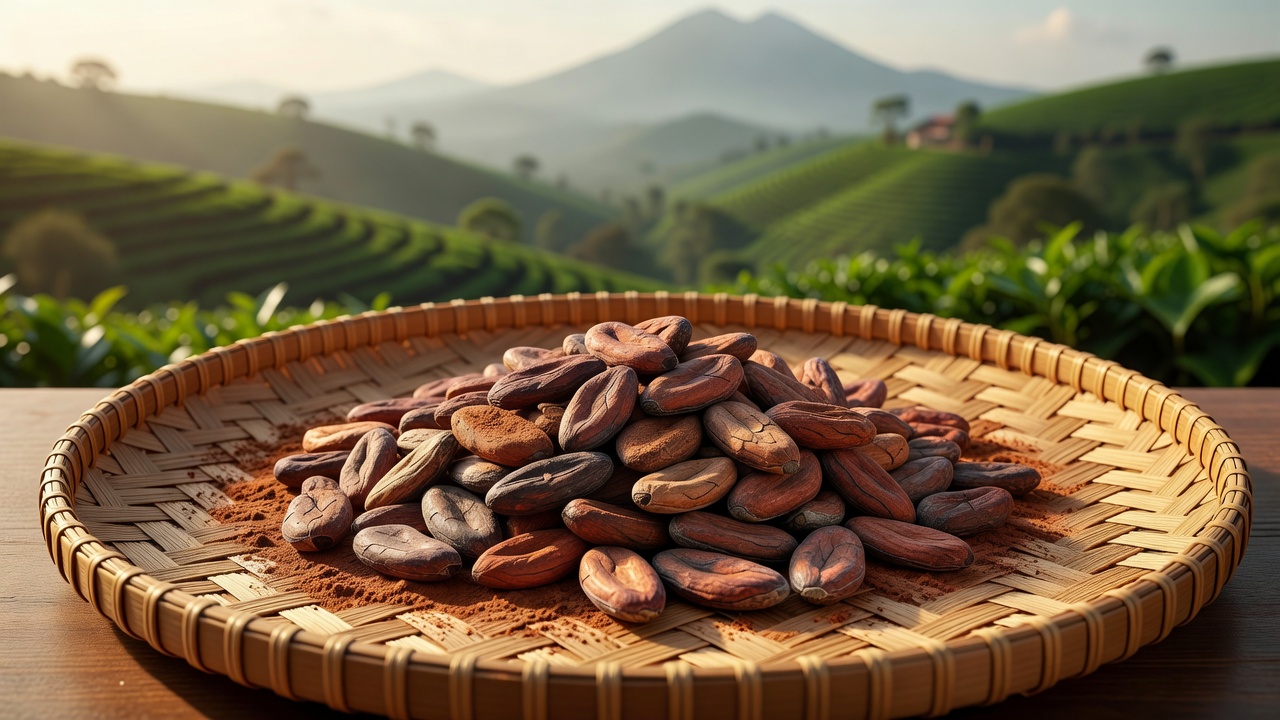
Certification changes more than what farmers spray; it changes what happens after harvest. Our partner stations produce properly fermented cocoa using 5–7 day box fermentation with regular turning — the critical step that develops the flavor precursors chocolate makers depend on. Beans are then sun-dried on raised beds to a stable 7–7.5% moisture and checked with cut tests and fermentation counts before bagging. Well-handled fermented cocoa shows cut-test scores of 75% or better, low mold incidence, and the clean, full-bodied profile that distinguishes quality Indonesian beans from quick-sold, unfermented lots.
What This Means for Bulk Buyers in the 2026 Season
For importers, food manufacturers, and traders, the organic transition translates into concrete sourcing options. TasikSpice currently supplies:
- Conventional Sulawesi cocoa — Grade 1 quality, moisture max 7.5%, moldy beans max 4%, approximately 100–120 beans per 100 g, sun-dried and hand-sorted.
- In-conversion lots — grown under organic protocols with conversion documentation, ideal for forward contracts ahead of full certification.
All lots are packed in 60 kg jute or polypropylene bags with inner liners, loaded at approximately 18 metric tons per 20-foot container, and shipped FOB Tanjung Priok, Jakarta, under HS code 1801.00. Standard export documentation — certificate of origin, phytosanitary certificate, and fumigation record — accompanies every shipment, and sample lots are available for pre-shipment inspection and laboratory testing. Pricing is quoted on request per current market, reflecting the 2026 harvest's quality and availability.
If your company is building an organic line for 2027 and beyond, now is the time to establish a sourcing relationship. Contact TasikSpice on WhatsApp at +62 812-9869-9940 to discuss contract volumes, request a sample of the current fermentation batches, or arrange a virtual farm visit with our partner cooperatives.
Patience, Proof, and Partnership
Organic certification cannot be bought or rushed — it is earned over three seasons of disciplined work in the field. That discipline is exactly what makes certified Indonesian cocoa valuable: buyers receive not only a compliant product, but a supply chain they can show their own customers with confidence. TasikSpice is proud to walk this road alongside the farming families of Sulawesi, Sumatra, and the Tasikmalaya highlands.
Ready to secure traceable Indonesian cocoa for your 2026 and 2027 programs? Message TasikSpice on WhatsApp (+62 812-9869-9940) for current FOB pricing and the 2026 harvest report.
Interested in sourcing premium Indonesian spices?
Contact TasikSpice on WhatsApp for FOB pricing, samples, and MOQ details.